Coping with Depression
Depression is categorized as a serious medical condition in which a person feels very sad, hopeless, and unimportant and often is unable to live in a normal way. The problem is that it is not taken as seriously as it should be. It is considered in India to be a made up problem of the privileged. The gravity of the situation is not understood. The National Crime Records Bureau statistics reveal that a total of 1,35,445 people committed suicide in 2012 which amounts to an average of 371 suicides daily. According to WHO, India is the most depressed country in the world with at least one in five women and one in ten men suffering from major depressive disorder at some time in their lifetime and accounting for 32% of the world’s suicides, but how often do we hear an open dialogue about it?
According to Dr. Harish Shetty, the symptoms of depression are something we might see in ourselves or in people around us in our daily lives viz. excessive exhaustion, snapping easily, having difficulty in concentrating, recurrent miscommunication, obsessively needing to rush home after work, being preoccupied with gadgets and/or continuously putting down colleagues on mails and social media. All of us would have personally experienced these symptoms at some point in our lives but does that mean we are all depressed?
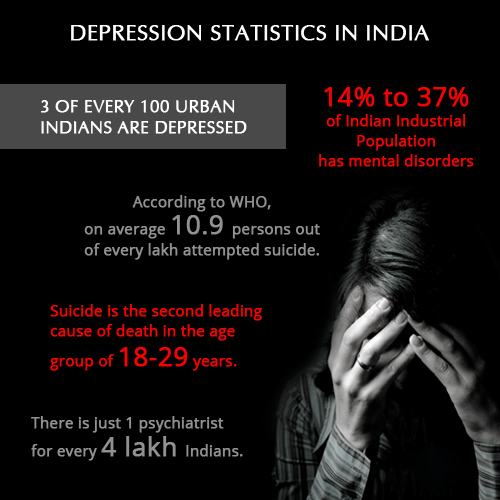
The causes could vary from neglect to physical abuse to financial difficulties to job problems to medical issues to the loss of a loved one to relationship troubles and so on but many times, there isn’t even a reason. Everything in your personal and professional life could be at its peak and you could still be unhappy because depression mostly always isn’t externally caused. 20% of corporate India is suffering from depression and for people at high-risk jobs, depression has become a given but most people who self-diagnose themselves as being depressed, still don’t admit it and/or get treated for it for the fear of being stigmatized at work or overlooked for promotions. Even if they do decide to get professional help, they do it externally, not through their organization.
But even seeking professional help isn’t easy. Rajesh Sagar, associate professor of psychiatry at New Delhi’s All India Institute of Medical Sciences, told DNA that there is just one psychiatrist for four lakh Indians. In the entire country, there are only 4,000 psychiatrists, 1,000 psychologists and 3,000 social workers and only 1,022 college seats for people seeking degrees in the mental health field. Until 2014 the Indian government spent less than 1% of its health budget on mental health. India’s first official National Mental Health Policy was released in October 2014 which was instrumental in opening a public dialogue about depression and mental health in general.
But why is there a stigma in the first place? Why can’t we talk about mental health as openly as we discuss our physical health issues? How do we break the stigma?
How many of us are really happy with our work? That includes our individual job profiles, our relations with our colleagues, our relations with our bosses, and the company we work for. Most of us aren’t but most of us believe it is normal to be unhappy about our work just because most people are. But is it really?
I personally have been badly affected by stress at work. I changed multiple jobs just to find myself unhappy at yet another job at yet another workplace. I made a lot of money and was very successful in everyone’s eyes. If I told anyone that I was depressed, nobody would believe me because they would find no reason for it. But I have had five episodes of severe depression and what’s worse is that I felt guilty for it. I felt I was too privileged to be upset about my life. I was good at my job, everyone was happy with me at work and at home, and I made a lot of money. So I couldn’t understand why I was depressed. I would have a really productive day at work and then come home and cry myself to sleep. I wasn’t happy and I couldn’t figure out why and that was the most frustrating thing of all.
But the thing is when I decided to open up about it; I learnt that a lot of people felt the same way. Most people experience “Monday blues” but why? Why should we feel routinely unhappy about one day every week? Why is this negative connotation attached to work? Shouldn’t we being doing what we love? How many of you do what you love?
Life coaching is not about giving advice, but about helping you regain access your own inner wisdom so that you feel aligned with your best self at the end of the day.
Schedule a discovery session today to find out what’s holding you back from living your most extraordinary life. Drop me a mail on jasmir@jasmirthakur.in or give me a call on +91 9820238574